
Plyo AS
Investigating the conceptualization of
an AI-Assisted Buyer Experience for Real Estate
This project was conducted under a confidentiality agreement with Plyo AS. This case study documents research process, analytical methodology, and conceptual output. Detailed product visuals are intentionally limited.
Project Overview
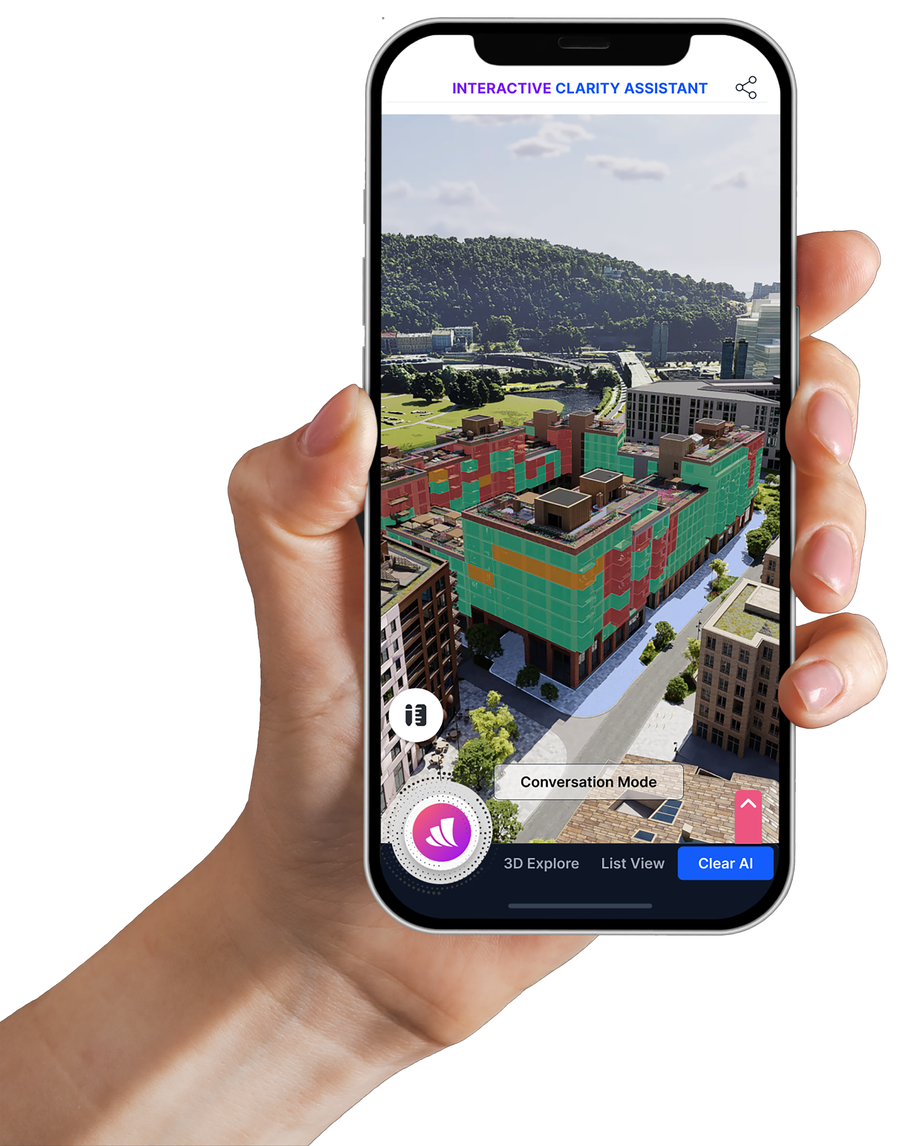
Plyo AS is a Norwegian prop-tech company offering an all-in-one platform for new property sales. Following a 2023 merger with 3D Estate, their flagship product is Explore: an immersive 3D environment powered by Unity that lets buyers navigate unbuilt properties before construction is complete.
This was an individual UX consultancy internship over twenty weeks. The brief was open-ended: investigate how UX design and AI could improve the pre-sales buyer experience inside Explore. What began as an interface project became a research-driven investigation into buyer psychology, behavioral data analysis, and the conceptualization of an AI service layer.
View Explore Live Demo →The Research Question
Why do most buyers browse Explore and disappear without converting*? And could an AI service built on that same behavioral data close the information gap for buyers while restoring realtor time to what it is actually for?
* Converting, in real estate sales, means a visitor transitions from anonymous browser to a known lead, entering the broker's pipeline where they can be actively supported.
Context
Norway's new-development housing market has been tough for four years. Residential construction is far below the estimated national need of 26,500 homes annually (Prognosesenteret), and the numbers keep getting worse: February 2026 saw 21% fewer new home sales and 38% fewer housing starts than the same month the year before (Boligprodusentene). The news tells us that project owners are pausing construction because of lack of financial backing. Demand only grows, and what is available does not become cheaper.
This is the scene for someone deciding whether to take the step. Mortgage rates are high, prices inflated, and the property they are considering does not yet exist. The hesitation a buyer carries is proportional to the debt they are about to commit to. The question is not only which apartment, but something many people quietly ask themselves: will this period end, and will the market correct after I have bound myself and my family to such an investment?
Many will not say that out loud. Not to a realtor, not to a professional, sometimes not even to people close to them. They browse a platform, they wonder, and they leave.
The information exists. Project specs are comprehensive: floor plans, finishes, pricing, technical data. Buyers still call to ask what is in them. The gap is not missing information, it is information not built for someone on their phone at 11pm deciding whether this project is worth a closer look.
Sales teams receive weak or unclear leads and invest real time in early-stage orientation, answering questions that project specs already cover. Those conversations rarely reach commitment. Brokers are absorbing an information delivery role that should not reach them in the first place. Their value lies further along the decision arc.
Reaching out to a realtor signals serious intent. For a buyer who is still unsure, that threshold is too high. They need answers before they are ready to be a lead. The question of whether they are ready to talk to someone comes long before the question about ceiling heights or parking.
Buying in a volatile market means committing to years of debt under uncertain conditions. That level of financial exposure creates real anxiety, and anxious buyers hesitate, stall, and leave. Many will not admit their doubts to a professional, or perhaps to anyone at all. Shame, maybe. A judgment-free space to get informed changes that dynamic.
Most visitors browse without leaving a trace. No contact form, no demographic data, no signal of intent. An intelligence layer observing behavioral patterns could transform this uncaptured traffic into actionable insight, helping buyers find something worth investing in and giving brokers a richer picture of who shows up and what actually holds their attention.
Norwegian new-development realtors operate closer to sales administrators than personal advisors. They manage lead banks, coordinate marketing, and run pre-sales logistics. Answering questions from hesitant, early-stage browsers is not their primary function. The gap between a curious visitor and an informed buyer is structural, not a failure of anyone's effort.
Stakeholder Study
To understand the scope of impact, value and ecosystem I conducted a stakeholder mapping. The two main stakeholders affected by the development of such a service turned out to be the buyer and the realtor. This was studied through interviews and conversations with internal stakeholders, with this theme and their vision of how an AI-Assistance could be of help for their clients in focus.
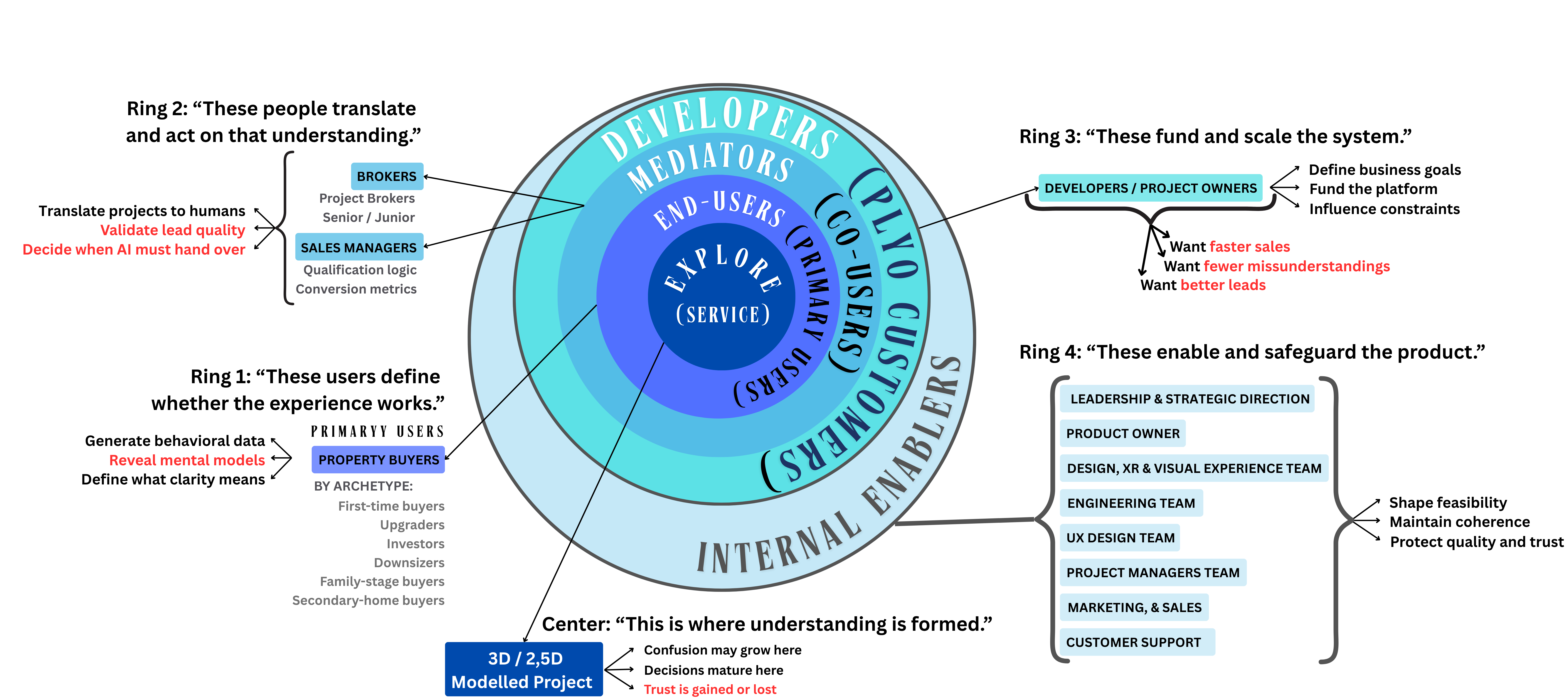
Mapping of the stakeholder ecosystem
The map organizes four rings around the Explore service at its center: property buyers as primary users, brokers and sales managers as the mediating layer, property developers as the funding layer, and Plyo’s internal teams as enablers. Each ring documents what they need, what they want, and the role they play in whether trust is formed or lost at the point of decision.
Main Users
The primary end user is the buyer, the target of the AI Assistance Service. Realtors are not end users, but their workflow is directly affected by the service existing. Their needs became clearer after a conversation with each user group.
Buyer side
Anxiety is lowered by immediate, accurate information delivered at the moment of hesitation. “Lost Fish” moment, where the buyer exits or requests a realtor contact, but it's only a napping on the hook (no commitment, equal “a poor/cold lead”).
Needs: fast, reliable information to resolve uncertainty before reaching out.
Realtor side
Anonymous browsing becomes partially visible. Realtors receive richer behavioral context and signals rather than cold contact submissions, to know when a buyer is worth their time and free capacity for outreach and real qualification work.
Needs: richer signals, reduced time in information delivery rather directed to managing what drives sales: reach, access, and the relationship close.
The conversational nature of the architecture opens a secondary value loop for Plyo: anonymized interaction patterns should accumulate into richer behavioral signals rather than click data alone.
1 in 3
visitors click "show interest" under 1 minute after opening Explore
Were these early clicks users already decided, like the couple who came with finance arranged and a lifestyle match in mind? Or buyers looking for someone to explain the platform to them? Either way, the pattern holds: the window for intervention is short. The project shifted from designing a better interface toward designing an intelligence layer that reads what the platform already knows and acts on it at the right moment. The assistant needs to appear quickly, and give the buyer a clear path to a real person when they need one.
User Research
Buyer
User profile
Retired couple. Purchased a new-development apartment approximately two years before handoff. Decision anchored in community trust: 60+ years of USBL cooperative membership and friends already moving into the same complex. Their interaction with the realtor was limited to financial paperwork and contracts, handled through the bank. The developer, with a physical office at the construction site, was their primary and most trusted point of contact, where they could just drop in when any questions would arise.
NOTE: The couple was not a Plyo user and had no awareness of Explore. The interview was conducted independently.
A paper prospectus was enough
Information was accessible, no need for digital artefacts. Their needs were fully met through people and in-person visits to the project office. The digital gap was simply never felt.
Earlier visibility, better outcome
They would have entered the market 6 months earlier to secure a better unit. The AI service needs to occupy that earlier window, before the decision anchors elsewhere.
The yes-moment was a life-style match
Floor plan drawings and the view from the balcony drove the decision. Specifications and 3D renders did not factor in. Emotional projection, not data, closed the purchase.
Locally integrated, community based approach
Their decision was already made before they engaged with any platform. Word of mouth and personal networks drove it. If they had been searching rather than referred, Plyo's Explore would have been the first place they landed.
Trust was human and physical
Presence built confidence in a way no digital interface could. The trust anchor was physical and recurring, not a platform feature. This is the gap the AI service cannot fill, but can help bridge for buyers who do not have that anchor.
Surprising New development Value
The fresh start effect created a stronger sense of community and belonging. The equality among neighbours of wide demographics brought engagement, proactivity and ownership. New development delivers a quality of communal life that resale rarely replicates.
Realtor
User profile
Senior realtor at Privatmegleren, one of Plyo's key clients. Operating in the new-development segment for many years across multiple projects listed on Explore. Has direct and regular experience with the full buyer-to-close cycle on digital-first property platforms, worked previously with resale real estate.
Show interest = I have questions
The contact button is not a buying signal. It is a request for orientation. Most incoming leads are looking for someone to explain the platform to them, not to commit. The realtor ends the call having answered questions, not advanced a deal.
Two kinds of calls
The realtor's most productive conversations start from a foundation the buyer built themselves. When a buyer arrives already informed, the call moves straight to what matters. When they arrive confused, it becomes orientation. The AI layer changes which call the realtor gets.
Short contact, low conversion
Time spent on early-stage prospect calls produces minimal results. The buyer arrives with basic questions that should have been answered before they ever reached out. The realtor spends the session orienting rather than qualifying, and the buyer rarely follows up.
Act now or lose them
The decision window is narrow. Buyers not engaged immediately move to another project. Two and a half years of the same pattern, with no current tool to change it. The intervention needs to happen on the platform, before the buyer decides it is not worth their time.
Most visitors are invisible
The majority of platform visitors leave without any contact or signal. The realtor cannot follow up on interest they cannot see. An intelligence layer changes this equation entirely. Every invisible session is a buyer the system could have learned from, and did not.
Expertise that cannot scale
Every session, the realtor reads signals: tone, hesitation, which questions someone asks, what they avoid. That pattern recognition lives entirely in their head, not in any platform. When the session ends, the knowledge evaporates. The learning agent concept came directly from this: capturing and scaling what the realtor already knows.
Methodology
Six methods were applied across the twenty weeks, each chosen for a specific constraint it could address. Access to research participants and internal data arrived later than planned, requiring the order and emphasis of methods to adapt as the project progressed.
UX Audits
Three Explore projects were audited across both desktop and mobile, alongside an internal prop-tech tool in prototype phase. Each was evaluated using heuristic principles, first-time-user walkthroughs, and inspection of navigation clarity and information architecture. Findings from the prototype audit fed directly into the tool's final deployed version.
Qualitative Research
Two interviews were designed to bracket both sides of the service: a buyer who had recently completed a new-development purchase, and a senior realtor at Privatmegleren, a long-term Plyo client. The pairing was deliberate, mapping the same decision from opposite ends of the transaction. Access constraints shaped the sample size. The distinction between new-development and resale buyer contexts would have required careful participant filtering regardless.
Investigative Research
With limited access to Plyo's user base, research adapted. Structured observation extended to documentary, industry, and reality programming covering real estate transactions, alongside extended AI discussions. Behavioral patterns in buyer hesitation, trust formation, and the realtor-buyer dynamic were mapped to build the buyer journey model. The implications are explored in Reflection.
Behavioral Data Analysis
Access to platform analytics was granted after direct escalation to a co-founder. SQL queries were written independently to extract intent signals and correct cross-site data contamination that had initially distorted the conversion picture. Correcting it changed the entire story: what looked like a failure was a signal-interpretation problem, not a conversion one.
Wireframe Conceptualization
Two Figma iterations were developed: a first exploring modal navigation between Explore modes, and a refined dual-intelligence architecture separating buyer-facing and broker-facing layers. Neither was user-tested due to restricted platform access. Both served as conceptual demonstrations of mobile screen-space allocation and the dual-layer service model for stakeholder communication.
Context Engineering
A local AI agent was configured using DeepSeek-R1 on Ollama and grounded against Plyo's constitutional document. Running a clean model against a constitutionalised version revealed a critical finding: factually accurate responses can still erode trust when framed to reflect what the user wants to hear. This shaped the assistant's tone constraints, activation logic, and handoff choreography throughout the concept.
Quantitative Findings: The Intelligence Gap
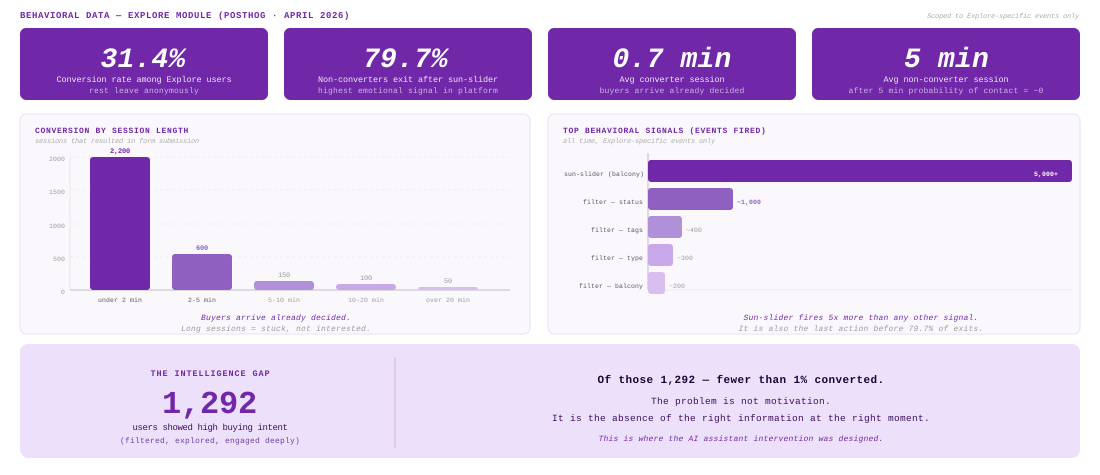
Platform analytics were scoped to Explore-specific events from November 2025 onwards. Exact figures are confidential. What is shown here are patterns from late April 2026, included to show how behavioral data can surface a story that raw traffic numbers miss.
Platform analytics showed a 31.4% conversion rate among users who reached Explore, a strong signal for a category this complex. The challenge is not conversion quality among engaged users. It is everyone who never reaches that point, and those who explore deeply and leave without a trace. The sun_slider_adjust_balcony event was the most fired intent signal in the platform: users simulating sunlight on virtual balconies. 79.7% of non-converting users fired it as their final action before exiting. Users who converted averaged 0.7 minutes. Non-converters averaged 5.
This is counter-intuitive. Extended browsing correlates with disengagement, not commitment. The deepest emotional signal in the platform is also the exit point for the majority of engaged non-converters. That is where Claire needs to be.
PostHog analytics scoped to Explore-specific events, April 2026
The Buyer Journey Model
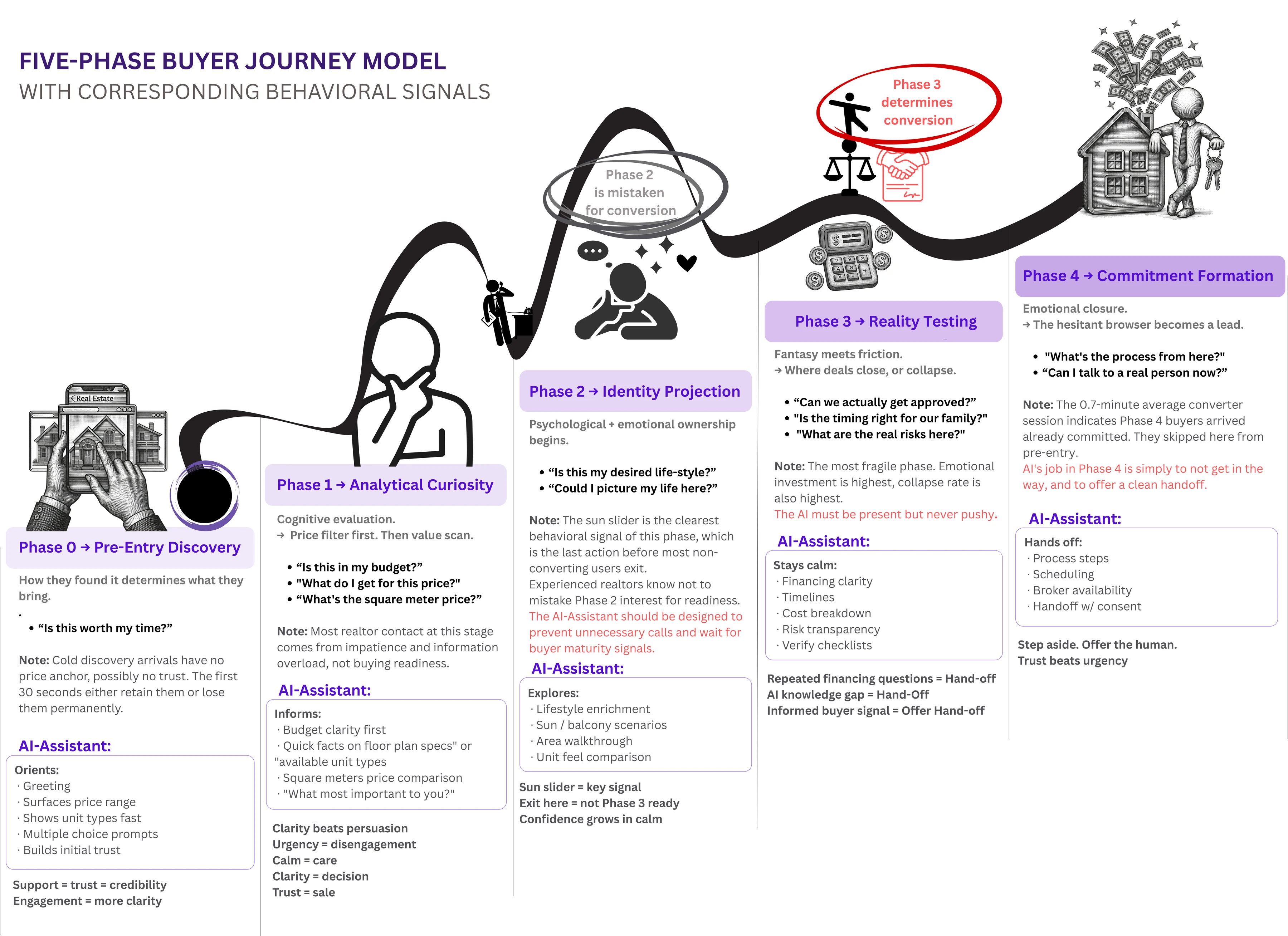
Five psychological phases shape how buyers move from first glance to signed contract. Each maps to one of Don Norman's levels of emotional design (visceral, behavioral, reflective) and carries a distinct behavioral signal and a different job for the AI.
First Contact
Visceral
Price is the first filter. Too expensive? They leave before they start. The AI's job here is speed and clarity.
Signal: quick scan, bounce on price mismatch
Analytical Curiosity
Behavioral
Comparing specs, prices, layouts. Low attachment, high evaluation. Not yet invested.
Signal: filtering, browsing, unit comparisons
Identity Projection
Visceral + reflective
They are imagining their life here. Emotional ownership has begun. The sun-slider is the tell.
Signal: sun-slider, repeat visits to the same unit
Reality Testing
Behavioral
Financing, timing, family decisions. The most fragile phase. Where deals close, or collapse.
Signal: long sessions, no conversion, exit after sun-slider
Commitment Formation
Reflective
The decision is already made. They open Explore to confirm it, not to explore.
Signal: short session, direct form submission
Five-phase buyer journey model with corresponding behavioral signals
AI & Context Engineering
With the behavioral gap mapped and the buyer journey modeled, the work moved into a question the research alone could not answer: how should an AI assistant actually behave in a trust-sensitive, high-stakes environment. Understanding this required doing, not only designing. Three practical experiments were set up to experience the implications before building around them.
Experimental Investigation
n8n Automation: Dynamic Knowledge Extraction
An n8n workflow was built to explore how broker domain knowledge could be captured without lengthy interrogation sessions. The core finding: knowledge and memory surface differently depending on context and moment. A single marathon session loses texture that a series of short, situational prompts preserves. This directly shaped the Learning Agent design: asking 2 to 4 targeted questions per session, triggered by real-time observation, rather than extracting everything at once.
Constitutional Prototype: Grounding in a Document
An assistant was grounded in a markdown version of Plyo's constitutional document, defining values, communication principles, and decision boundaries. The responses were directionally correct but lacked the social calibration to feel convincing in a real buyer conversation. The constitutional approach itself was sound. The model beneath it was not built for human interaction. A model with stronger empathic reasoning would have changed the result significantly.
Local Agent: The Risk of Over-Agreement
A local DeepSeek-R1 agent was run without constitutional grounding to observe unconstrained behavior. The responses were fluent and agreeable. That was the problem. In a context where buyers are internally testing a major financial commitment, an assistant that validates every concern with ease does not feel honest. It feels compliant. The output was not inaccurate. It was too comfortable. That dissonance produced something more corrosive than distrust: quiet skepticism.
Key finding
Factually accurate responses can still erode trust, by invoking silent skepticism.
Insights
Architecture and model in symbiosis
An AI system sharpens through what surrounds it: the documents grounding it, the expertise fed into it, the interactions teaching it. But the base model is its foundation. Some models carry a stronger human language orientation than others, and that difference shapes how convincing the system feels regardless of how well it is configured. Architecture provides structure. The model provides character. Both must be chosen in symbiosis.
Domain knowledge extracts better contextually
Expertise surfaces in short, situation-specific moments, not in structured interviews. Memory is contextual: what a broker knows surfaces best when a live situation calls for it, not when asked to reflect in the abstract. A system that asks the right question at the right moment captures more than a marathon onboarding session ever could.
Over-agreeableness is its own form of deception
In high-stakes decisions, buyers test reality internally before they test it out loud. An assistant that meets every concern with reassurance does not feel supportive. It feels like it is hiding something. Skepticism follows.
Credibility belongs to the institution, not the AI
In a purchase of this size, buyers do not trust an AI's confidence. They trust a developer's documentation, a broker's voice, an established platform. The assistant should carry their authority, not build its own.
What this produced
The experiments produced more than design constraints. They produced a map of the system. A Service Blueprint made the interactions explicit: every touchpoint, every data flow, every decision point across buyer, broker, AI, and platform layers. What that map revealed was the argument for a multi-agentic architecture.
Two different users with fundamentally different needs already implied at least two distinct agents. But the governance requirements the experiments uncovered demanded more: preventing hallucination, blocking pressure language, isolating buyer-facing responses from broker intelligence, managing the handoff. Each role needed its own agent: specialized, accountable, collaborating without interference. Complexity at that level of interaction requires safeguarding by design, not as an afterthought.
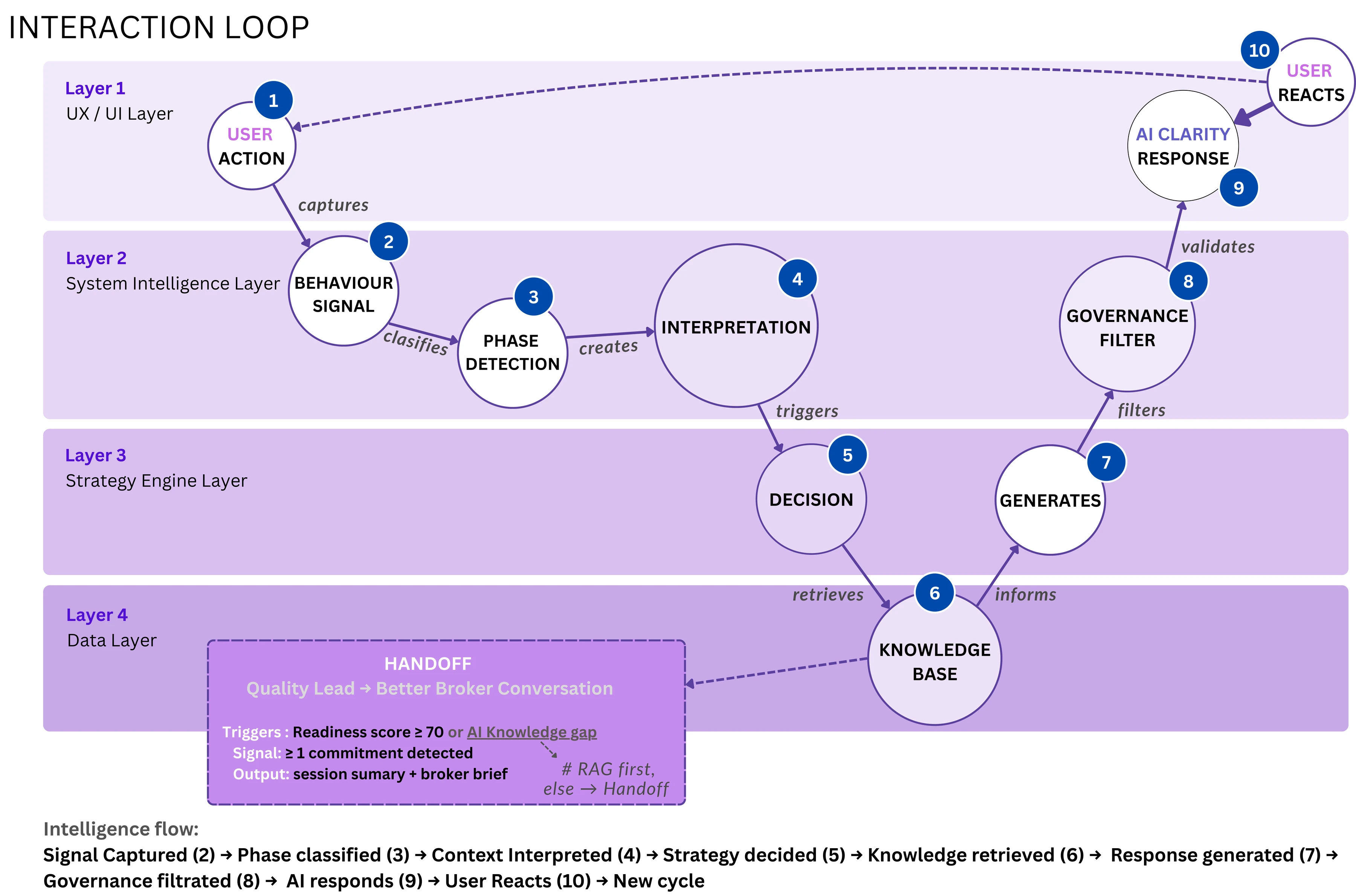
Four-layer system: buyer experience · tracking · knowledge · AI agent collaboration
LAYER 1 · Front layer (Plyo Explore + AI Clarity Assistant)
What the homebuyer experiences:
3D/AR exploration: Units, balcony, sun paths, surroundings, hotspots/POIs
Assistant presence: quiet-by-default, proactive only when it adds clarity. Observant and Phase-aware. (core product differentiation)
LAYER 2 · Tracking + Monitoring (Event stream + DataHub)
Navigation events · Revisit patterns · Question topics · Time spent · Comparison depth
Phase Detector · Readiness Score · Handoff decision logic
Behavioural Intelligence Engine: merges signals into a unified readiness signal per session
Phase 0 → 1 → 2 → 3 → 4 → Handoff
LAYER 3 · Knowledge layer (curated specs + documentation)
Project Knowledge Base (per development): curated, versioned sources
Unit specs, Material lists, Floorplans, Pricing · Warranty terms, Delivery timeline, QA/handover docs
HOA/common costs, utilities, parking/storage · Local context: transport, schools, Municipal planning links, noise zones
Retrieval-first rule: if not in docs, the assistant refers rather than guesses. Prevents hallucinations.
LAYER 4 · AI “Backroom team” (Multi-agent collaboration)
MODULE 1 Behavioural Intelligence Engine
Inputs: Navigation events · Revisit patterns · Question topics · Time spent · Comparison depth
Output: readiness signal · Phase · Handoff
MODULE 2 Conversation Strategy Engine
Stay silent · Contextual explanation · Suggest clarity · Ask neutral question · Offer broker connection · Soften alignment or presence
MODULE 3 * Essential Knowledge Retrieval
Retrieve project docs · Retrieve location context · Retrieve regulatory info · Provide citations
Prevents hallucination: retrieval-first. Never generates ungrounded facts about a specific property.
MODULE 4 Governance + Safety Layer
Filter pressure language · Block speculation · Enforce uncertainty framing · Remove biased statements · Enforce info vs advice boundary
MODULE 5 Broker Insight Generator
Input: Interaction history · Behavioural signals · Readiness score · Top concerns
Output: Broker summary · Talking points · Suggested next steps · Buyer readiness score, warm intro (not a cold lead)
MODULE 6 Learning Agent
Observes broker sessions alongside the realtor and asks 2 to 4 targeted questions per session when gaps are detected
Broker expertise feeds the knowledge base over time without affecting any live conversation · Buyer interaction patterns feed from the other side
Both channels make the system progressively more attuned to real market behavior
Behaviour Intelligence → Conversation Strategy → Knowledge Retrieval → Governance Filter → Assistant Response → Broker Insight Generator → Learning Agent
The dual-intelligence concept did not emerge from a brief. It came from the constant movement between empathy and definition that design thinking demands, even without formal testing, even without direct collaboration with Plyo. User-centricity was not a lens applied on top of the work. It was the reason the work led somewhere real.
Institutional grounding
The agent was grounded in Plyo's constitutional document to anchor responses to the platform's brand and the developer's credibility, not to the AI's own authority. Institutional trust outperforms individual trust in high-stakes decisions.
Activation logic
Early but considered presence: Claire introduces herself quickly before buyers decide whether to stay. The broker interview reinforced this: a sales consultant at a physical showing is in the room from the start, not waiting in a side office for signs of confusion. The balance is proactive availability without sales pressure.
Prompting constraints
The assistant was constrained against urgency language, vague reassurances, and responses that over-simplify complexity. Each constraint came from a specific failure mode observed during the experiments.
AI assistant interaction loop: buyer layer, system intelligence, strategy engine, and data
The Concept: Dual-Intelligence Architecture
The combined research, behavioral analysis, and context engineering experiments converged into a dual-intelligence architecture: two complementary layers, one buyer-facing, one broker-facing, designed to work together without creating friction for either side.
Claire: Buyer-facing layer
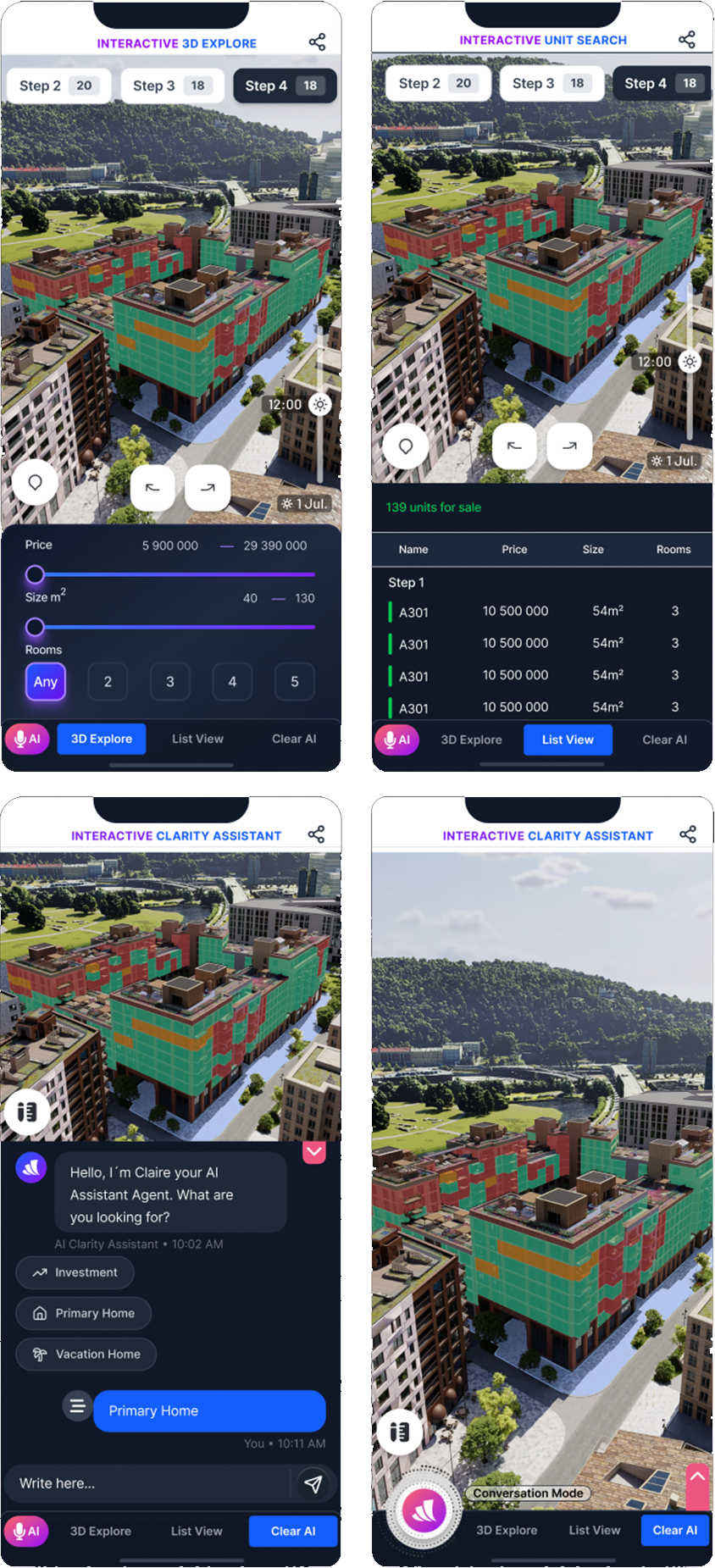
An adaptive AI clarity assistant built for mobile. Three interaction modes give buyers control over how they engage: spatial exploration, structured unit search, and direct conversation with Claire. A voice-enabled layer lets buyers talk through decisions out loud rather than type. Claire is present from the first moments of a session, available to guide, answer, or simply be there if the buyer needs it. Waiting for distress signals means missing most of the window.
Early presence, no pressure
Claire is in the room from the start, the way a sales consultant is already present when a buyer walks into a physical showing. Easy to dismiss, never pushy, and steps back if the buyer prefers to explore alone.
Three modes, one screen
Designed to solve mobile space constraints without reducing capability. Buyers switch modes without losing context.
Anonymous-first
No data required to start. Buyers explore fully and decide for themselves whether to share anything.
Accessibility by design
Conversation mode serves users with motor impairments, situational limitations, or a preference for hands-free interaction.
Spatial immersion
In AI chat view, a dedicated button collapses all interface tools from the Explore frame, removing visual clutter when the buyer does not need them. A slide-down control expands the 3D environment to full screen, leaving only the sticky mode bar at the bottom with the three modes and voice toggle. Buyers orient themselves spatially on their own terms, then return to guidance with one tap.
Contextual discovery
When a buyer voices a preference, Claire surfaces comparable units within that range and can pivot to neighbourhood context: nearby schools, transit, or local amenities. Exploration becomes conversational rather than menu-driven.
Voice as demographic signal
Activating voice mode triggers a consent form. Voice interaction patterns carry richer demographic data than text: cadence, vocabulary, and phrasing reveal what behavioural logs cannot. Buyers who consent contribute to a progressively sharper model of real buyer language.
Broker dashboard: Intelligence layer
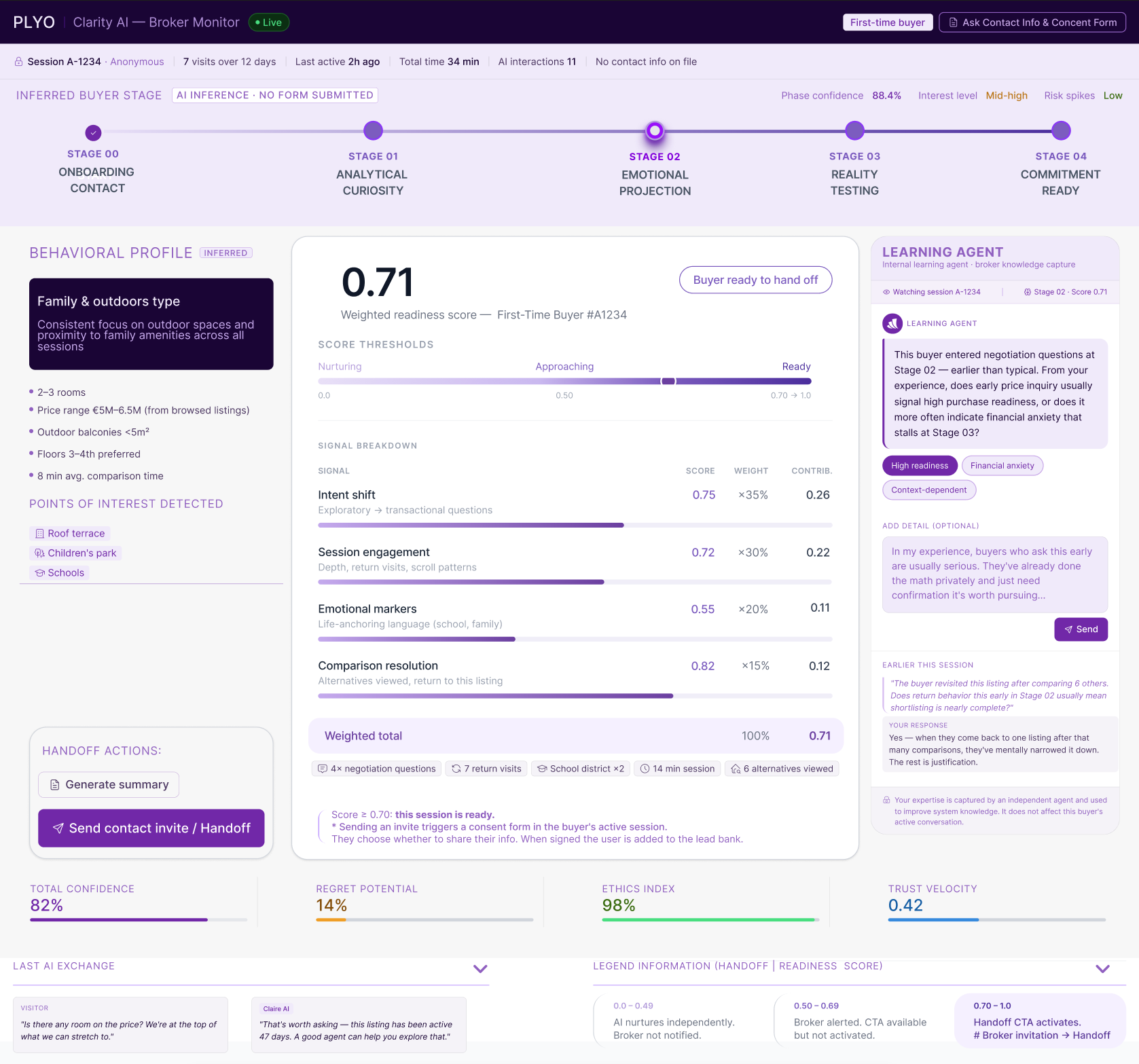
A monitoring dashboard for anonymous buyer sessions. Without any personal data, it surfaces inferred buyer stage, behavioral signals, and a consent readiness score built from intent shift, session engagement, emotional markers, and comparison resolution. When a session crosses the readiness threshold, the broker triggers a consent form in the buyer's active session. A dedicated learning agent observes each session alongside the broker, asking 2 to 4 targeted questions to capture domain expertise and continuously sharpen the system.
Behavioral profile
Built from browsing signals alone. No personal data needed to construct a rich picture of buyer intent and preferences.
Consent-driven handoff
The broker triggers a form in the buyer's active session. Personal data only enters the system when the buyer chooses to share it.
Proactive learning agent
Asks 2 to 4 targeted questions per session based on what it observes. Broker expertise feeds the system over time without affecting any live conversation.
Design Principles
Five principles shaped the architecture of both service layers, grounded in the trust-formulation finding, the qualitative interviews, and the behavioral data.
Freedom and control
Both users retain agency. Buyers choose whether to engage with Claire, share information, or request broker contact directly. Brokers monitor anonymous sessions and can step in discreetly, signalling that a human is available when the buyer is ready. Buyers gain an easier path to answers on their own terms; realtors gain time back for the conversations that actually matter.
Active presence, considered pace
Most buyers spend under 5 minutes on a platform. Claire is in the room from the start: approachable, easy to dismiss, never pushy, never creating urgency. She does not over-promise or avoid difficult questions. Honest answers, even uncomfortable ones, build more trust than reassuring ones. The buyer gets timely help on their own terms. Plyo gets data from sessions that would otherwise leave no trace.
Data is intelligence
Most platforms only capture when a buyer converts. Plyo captures why they almost did. Every session adds behavioral depth: attention patterns, hesitation points, exit moments. Developer clients gain demand signals that traditional market research cannot match in real time. The platform grows more valuable with every visit, enabling Plyo and its clients to adapt to market shifts before they surface elsewhere.
Consent-driven handoff
Contact is always buyer-initiated; visitors stay anonymous until they choose otherwise. Credibility is anchored to Plyo's brand, not the AI. Every session enriches the behavioral database with buyer profiles and decision patterns for future projects. Behind both layers, specialized agents cross-check outputs and keep data isolated between roles, making the architecture trustworthy as it matures.
Continuous learning
A dedicated learning agent observes broker sessions alongside the realtor, proactively asking 2 to 4 targeted questions per session when the system detects possible gaps. Broker expertise feeds the knowledge base over time, making the AI progressively more attuned to real market behavior without affecting any live conversation. The more brokers engage, the sharper the system becomes. The assistant also learns from buyer interactions, making both sides of the platform a continuous feedback loop.
Discussion & Limitations
The evidence suggests a trust-calibrated mediation layer can translate buyer signals into usable broker context. It does not prove it works. The concept remains unimplemented, untested with real users, and unevaluated for performance or safety.
The behavioral data exposed a wrong assumption at the center of the brief. The challenge was never conversion rate. It was the information environment buyers navigate before they are ready to commit. A system optimized for the wrong problem is not a slow solution. It is the wrong solution.
Building the buyer-facing agent well requires deep input from brokers. They interact with buyers daily and carry tacit knowledge no dataset captures cleanly: how buyers signal hesitation, what questions reveal real intent, how trust breaks down in practice. A structured research phase with brokers, through interviews and thematic discussions on buyer behavior, would be a study in itself. That knowledge should directly inform the agent's conversational design, buyer profiles, and journey mapping before the system is built.
Methodological note
Initial analytics showed a conversion rate that looked like a critical failure. It turned out to be cross-site data contamination from a 2023 deployment. Correcting it changed the entire story. Data literacy was itself a UX research practice in this project.
Open questions
Most remaining unknowns require a live implementation to address. Broker workflow integration, safety evaluation, and regional trust variation are the priority gaps.
Reflection
Ask before you wait
This internship ran in parallel with a bachelor thesis at another company. Twenty weeks, two concurrent major projects, two entirely different contexts. The cognitive load of dividing focus at that scale does not appear in a timeline, but it shapes every decision about when to push and when to wait.
Working alone on a multi-stakeholder project, with the only sparring partner absorbed into the company's own scaling, research became more intuitive than methodical. The core loss was user access. The realtor interview was postponed repeatedly until a direct, non-negotiable request resolved it the next day. Waiting carefully costs research time that cannot be recovered. Divided capacity makes that cost higher. A designer working inside a company with many competing priorities has to protect their research access, and ask for it assertively, not hopefully. That lesson arrived late in this project. It was the most durable one.
Escalate when blocked
After weeks of limited access, escalating directly to a co-founder unlocked analytics access, a realtor interview, and the constitutional document within days. Navigating a startup environment is itself a professional skill.
Data re-frames the question
The biggest finding was not in the data itself but in what it revealed about the original assumption. The conversion problem was not a conversion problem. Quantitative analysis produced a conceptual inversion that changed the entire design direction.
Trust is formulated, not just accurate
The context engineering experiments showed that factually correct responses can still erode trust when framed to reflect what the user wants to hear. This shaped the assistant's architecture from trigger timing to tone to handoff choreography.
Tools: Figma · Cursor · PostHog · SQL · Photoshop · n8n · Ollama · DeepSeek-R1 · Claude · ChatGPT · Canva